

Festival Foods in the Spanish-Speaking World
A guided read with exam-ready Spanish for GCSE.
Imagine this: you are walking through a crowded street in Valencia, Mexico City or Buenos Aires. There is music everywhere, people are dancing in colourful costumes and, most importantly, the smell of amazing food is in the air. Festivals in Spanish-speaking countries are not just about music and fireworks — they are about eating together, celebrating identity and sharing traditions with family and friends.
Throughout the article, the useful Spanish words and phrases are highlighted (with their meaning in brackets), so you can “steal” them for your speaking and writing. Tap the on any phrase to hear it.
In many Spanish-speaking countries, food is at the heart of any fiesta. A typical exam-style sentence could be:
En las fiestas, la comida es muy importante porque reúne a la familia
At festivals, food is very important because it brings the family together
This kind of phrase immediately shows you understand culture, not just grammar. Festival foods often:
- celebrate a religious event or a saint’s day;
- use seasonal ingredients, like autumn pumpkin or summer seafood;
- are shared in the street, in a una plaza (a square) or on a una terraza (a terrace);
- are linked to local identity, like paella in Valencia or mole in Mexico.
You could say in your exam:
Durante las fiestas, la gente suele comer platos tradicionales y especiales
During festivals, people usually eat traditional and special dishes
Spain has hundreds of local festivals, but here are some where the food is unforgettable and very exam-friendly.
Las Fallas (Valencia)
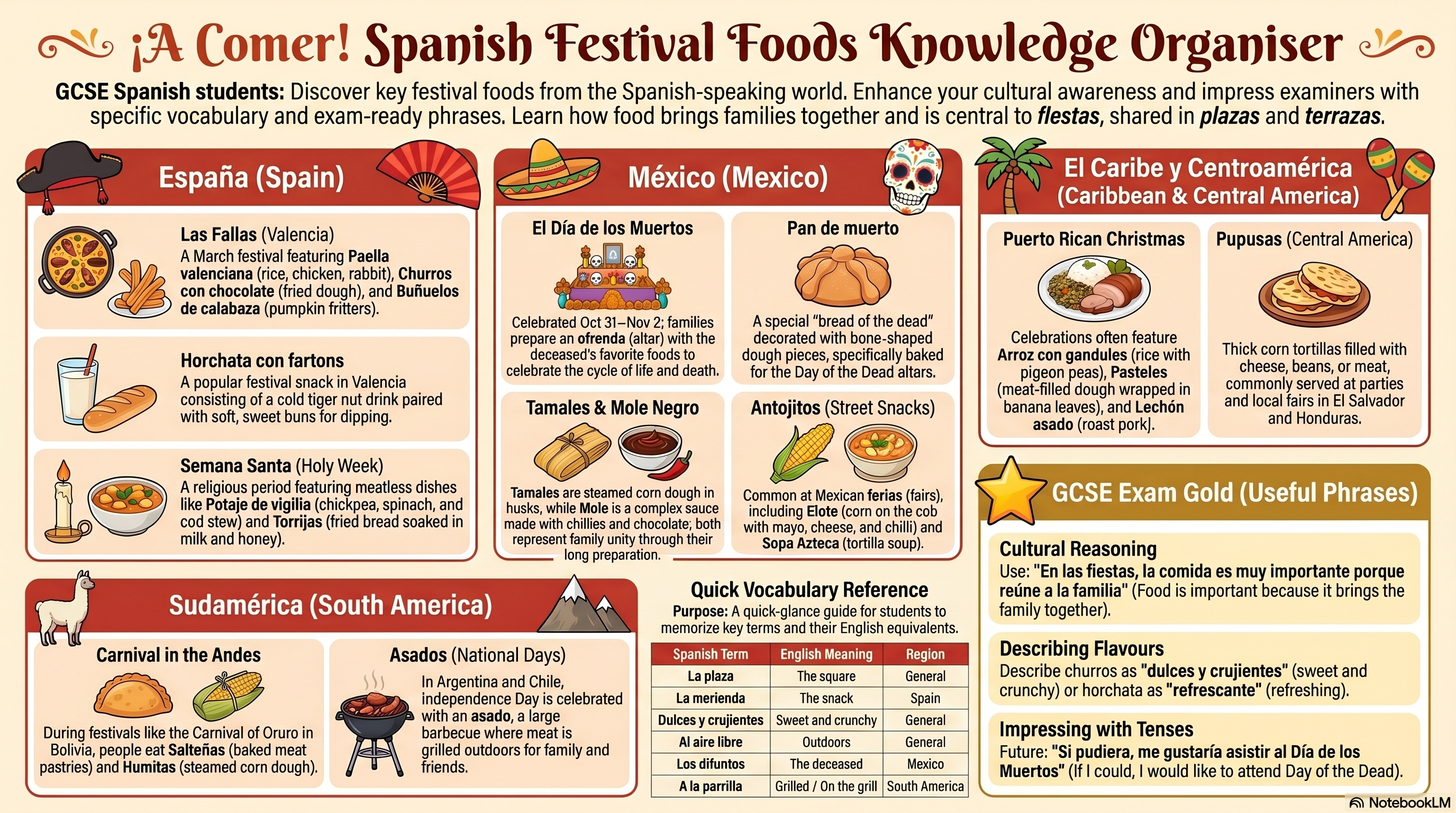
Las Fallas takes place in March in Valencia and is famous for its enormous sculptures that are burned at the end of the festival.
Sin embargo, para mucha gente, la mejor parte es la comida
However, for many people, the best part is the food
Typical foods you might mention:
- Paella valenciana — a rice dish with chicken, rabbit and beans, cooked in a huge pan. Se come al aire libre con amigos (It is eaten outdoors with friends)
- Churros con chocolate — long, fried dough sticks dipped in hot chocolate.
- Buñuelos de calabaza — little pumpkin fritters, fried and sprinkled with sugar. Son típicos de las Fallas (They are typical of Las Fallas)
- Horchata con fartons — a cold tiger-nut drink with soft, sweet buns for dipping. Es una merienda muy popular durante las fiestas (It is a very popular snack during the festivals)
Useful phrases for your exam
Me encanta comer churros con chocolate caliente porque son dulces y crujientes
I love eating churros with hot chocolate because they are sweet and crunchy
Durante Las Fallas hay puestos en la calle donde venden churros y buñuelos
During Las Fallas there are street stalls where they sell churros and fritters
Probé la horchata por primera vez y me pareció muy refrescante
I tried horchata for the first time and I found it very refreshing
Semana Santa (Holy Week)
In Spain, Semana Santa is a very religious festival before Easter, but it is also full of typical food:
- Torrijas — similar to French toast: bread soaked in milk, sugar and egg, then fried and covered in sugar or honey.
- Potaje de vigilia — a stew with chickpeas, spinach and cod, eaten on days when people traditionally avoid meat.
En Semana Santa muchas personas comen platos sin carne, por ejemplo potaje de vigilia y torrijas
At Easter many people eat dishes without meat, for example potaje de vigilia and torrijas
If you only learn one Mexican festival for GCSE, make it el Día de los Muertos (the Day of the Dead). It is exciting, visually stunning and full of food vocabulary.
El Día de los Muertos
Celebrated from 31 October to 2 November, it is about remembering loved ones who have died, in a joyful, colourful way. Families prepare an una ofrenda (an altar) with photos, candles, flowers and the favourite foods of the person who has died. Key foods:
- Pan de muerto — “bread of the dead”, a sweet bread decorated with bone-shaped dough. Simboliza el ciclo de la vida y la muerte (It symbolises the cycle of life and death)
- Tamales — corn dough filled with meat, cheese or chilli, wrapped in corn husks and steamed. Se preparan en familia (They are prepared as a family)
- Mole negro — a thick sauce of chillies, chocolate, nuts and spices, served with chicken. Es un plato especial que requiere mucho tiempo (It is a special dish that takes a long time)
- Pozole rojo — a hearty stew with hominy (large corn grains) and pork in a red chilli broth.
- Calabaza en tacha — pumpkin cooked slowly with brown sugar and cinnamon. Es un postre típico del otoño (It is a typical autumn dessert)
High-impact exam phrases
Durante el Día de los Muertos preparan pan de muerto y lo ponen en el altar para los difuntos
During Day of the Dead they prepare pan de muerto and put it on the altar for the dead
Los tamales representan la unión de la familia porque todos ayudan a prepararlos
Tamales represent family unity because everyone helps to prepare them
Me gustaría probar el mole porque tiene una mezcla interesante de chocolate y chiles
I would like to try mole because it has an interesting mixture of chocolate and chillies
Other Mexican festival foods
At many Mexican festivals, especially local las ferias (fairs), you also find elote (grilled corn on the cob with mayonnaise, cheese and chilli) and sopa azteca (tortilla soup with cheese and avocado).
En las ferias mexicanas venden comida callejera como elote y sopa azteca, que huele muy bien
At Mexican fairs they sell street food like elote and tortilla soup, which smells really good
Spanish is also spoken in the Caribbean and Central America, where festival foods mix Spanish, African and indigenous influences — great to mention to show cultural range.
Puerto Rico & the Caribbean
En el Caribe hispanohablante las fiestas duran muchas semanas y siempre hay platos enormes para compartir
In the Spanish-speaking Caribbean the celebrations last many weeks and there are always huge dishes to share
- Pasteles — like tamales, but wrapped in banana leaves and filled with meat and root vegetables.
- Arroz con gandules — rice with pigeon peas and pork, the national Christmas dish of Puerto Rico.
- Lechón asado — slow-roasted pork, often for big parties.
En Puerto Rico, en Navidad, muchas familias comen arroz con gandules y lechón asado en grandes reuniones familiares
In Puerto Rico, at Christmas, many families eat arroz con gandules and roast pork at big family gatherings
Central America — pupusas & more
In countries like El Salvador and Honduras you might find pupusas — thick corn tortillas filled with cheese, beans or meat, eaten at parties and local fairs.
En Centroamérica las pupusas son muy populares; son tortillas gruesas rellenas de queso o frijoles
In Central America pupusas are very popular; they are thick tortillas filled with cheese or beans
Me parecen muy ricas y llenan bastante
They seem very tasty and very filling
South American festivals are incredibly diverse, from the Andean mountains to the cities of Argentina and Chile. Many involve days of eating and dancing.
Carnival in Bolivia & the Andes
In Bolivia, Peru and Ecuador, Carnival and religious festivals mix Catholic traditions with indigenous culture. People might eat salteñas (baked pastries filled with meat, potatoes and a sweet-spicy sauce) and humitas (sweet or savoury corn dough steamed in husks, like tamales).
En Bolivia, durante el Carnaval de Oruro, la gente come salteñas en la calle mientras mira los desfiles
In Bolivia, during the Carnival of Oruro, people eat salteñas in the street while they watch the parades
Argentina & Chile — asados & national days
In Argentina and Chile, national days and local festivals often include an un asado (a barbecue). People grill beef, sausages and vegetables outside with friends and family.
En Argentina celebran el Día de la Independencia con un asado; se come mucha carne a la parrilla
In Argentina they celebrate Independence Day with a barbecue; people eat a lot of grilled meat
Personalmente, preferiría probar las empanadas porque no como mucha carne
Personally, I would prefer to try the empanadas because I do not eat much meat
To get higher grades, combine cultural knowledge with strong Spanish structures. Here are ready-to-use phrases you can adapt.
Talking about what people eat
Normalmente, durante las fiestas en los países hispanohablantes, se comen platos muy tradicionales como…
Normally, during festivals in Spanish-speaking countries, very traditional dishes such as… are eaten
En mi opinión, la comida de las fiestas es más sabrosa que la comida del día a día
In my opinion, festival food is tastier than everyday food
Lo mejor de la fiesta fue la comida típica, especialmente…
The best thing about the festival was the traditional food, especially…
Using tenses to impress
El año pasado visité una fiesta local donde probé…
Last year I visited a local festival where I tried…
Si pudiera, me gustaría asistir al Día de los Muertos para probar…
If I could, I would like to go to Day of the Dead to try…
En el futuro quiero viajar a Valencia para comer paella auténtica durante Las Fallas
In the future I want to travel to Valencia to eat authentic paella during Las Fallas
Opinions with reasons
Me apasiona la comida de las fiestas porque refleja la historia y la cultura del país
I am passionate about festival food because it reflects the history and culture of the country
No me gustaría comer chapulines porque no estoy acostumbrado a los insectos
I would not like to eat grasshoppers because I am not used to insects
Sin embargo, tengo ganas de probar el pan de muerto, ya que parece delicioso y simbólico
However, I really want to try pan de muerto, as it seems delicious and symbolic
Examiners love answers that sound real and show you know something about the culture, not just grammar tables. Here is a short model answer you could adapt in your speaking or writing exam when asked about festivals or food:
En los países hispanohablantes, las fiestas siempre están relacionadas con la comida. Por ejemplo, en Valencia celebran Las Fallas en marzo y hay muchos puestos en la calle donde venden churros con chocolate y buñuelos de calabaza. También me interesa mucho el Día de los Muertos en México; las familias preparan pan de muerto, tamales y mole para poner en un altar para sus seres queridos. En el futuro, me gustaría asistir a esta fiesta para probar la comida típica y sacar muchas fotos.
This means that in Spanish-speaking countries, festivals are always linked to food — with examples from Las Fallas and the Day of the Dead, plus a future intention to go. It uses several tenses, cultural details and expressive vocabulary: exactly what you need for the higher grades.