El Carnaval de Oruro
Bolivia’s most famous festival, where thousands of masked dancers perform the dramatic ‘Diablada’ — the dance of the devils — in a stunning blend of Andean and Catholic belief.
What is El Carnaval de Oruro?
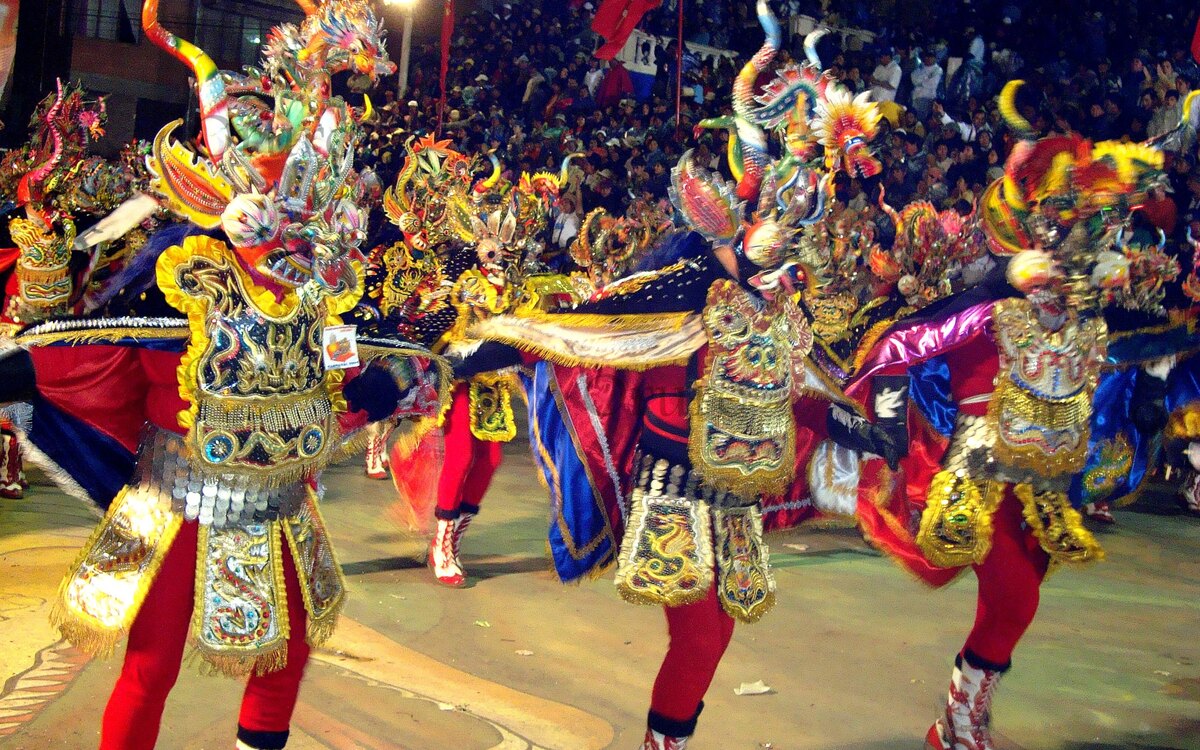
The dance of the devils
High in the Bolivian Andes, the mining city of Oruro hosts one of South America’s most striking carnivals. Its centrepiece is the Diablada — the ‘dance of the devils’ — in which dancers in elaborate, terrifying masks act out the battle between good and evil.
Two beliefs, one festival
The carnival is a remarkable mix of cultures: a Catholic pilgrimage in honour of the Virgen del Socavón (patron of miners) layered over much older Andean worship of Pachamama (Mother Earth) and the spirits of the mines. The procession lasts some 20 hours and covers around 4 km.
A heritage of humanity
Declared by UNESCO a ‘Masterpiece of the Oral and Intangible Heritage of Humanity’ in 2001, the Carnaval de Oruro draws hundreds of thousands of visitors and is one of the proudest expressions of Bolivian identity.
“La Diablada representa la lucha entre el bien y el mal con máscaras impresionantes.”
At a glance
Find it on the map
How to talk & write about it
This festival is perfect for Theme 2: Popular culture (customs, festivals & celebrations). Use it in the photo-card discussion and reading-aloud/conversation (Paper 2) and as a rich example in your ~90-word writing (Paper 4). Here is the language you need.
Key vocabulary
| el carnaval | the carnival |
| la diablada | the ‘dance of the devils’ |
| la máscara | the mask |
| disfrazarse | to dress up |
| el bien y el mal | good and evil |
| la procesión | the procession |
| conmemorar | to commemorate |
| impresionante | impressive / striking |
| la tradición andina | the Andean tradition |
| mundialmente conocido | world-renowned |
Model sentences (build up the tenses)
- PresentEl Carnaval de Oruro se celebra en Bolivia, en los Andes, antes de la Cuaresma.The Oruro Carnival is celebrated in Bolivia, in the Andes, before Lent.
- PresentMiles de bailarines llevan máscaras de diablo y bailan la diablada por la calle.Thousands of dancers wear devil masks and dance the diablada through the street.
- OpinionMe parece impresionante porque mezcla las tradiciones andinas y católicas.I find it impressive because it mixes Andean and Catholic traditions.
- PastDe pequeño no conocía esta fiesta, pero ahora me fascina su historia.As a child I didn’t know this festival, but now its history fascinates me.
- FutureMe gustaría ver la diablada en Bolivia algún día.I would like to see the diablada in Bolivia one day.
Structure a strong answer
El Carnaval de Oruro se celebra en Bolivia, en los Andes, antes de la Cuaresma.
The Oruro Carnival is celebrated in Bolivia, in the Andes, before Lent.
Miles de bailarines llevan máscaras de diablo y bailan la diablada por la calle.
Thousands of dancers wear devil masks and dance the diablada through the street.
Me parece impresionante porque mezcla las tradiciones andinas y católicas.
I find it impressive because it mixes Andean and Catholic traditions.
De pequeño no conocía esta fiesta, pero ahora me fascina su historia. Me gustaría ver la diablada en Bolivia algún día.
As a child I didn’t know this festival, but now its history fascinates me. I would like to see the diablada in Bolivia one day.
Examiner tips
- Photo card: start with en la foto hay… / se ve a…, then say what people are doing and wearing, then give an opinion.
- Justify everything: opinions score marks only with a reason — use porque, ya que, creo que, me parece que.
- Show off tenses: for the top bands, add a past (antes… / de pequeño…) and a future/conditional (me gustaría…) to your present-tense description.
- Connectives: link ideas with además, sin embargo, por eso and aunque to sound more natural.